




Highlights

Medical-grade* quality nebulizers

Safe for all ages, phthalate-free

Maximizing ease of use & maintenance
*OMRON's nebulizers confirm to the international medical device standards (IEC/ISO standards).
Respiratory Therapy


Frequently Asked Questions
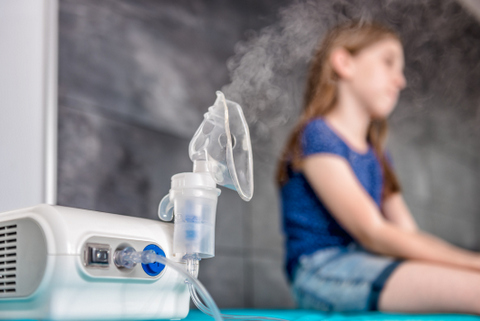
It is a device that can convert liquid medicine into aerosol droplets that can be easily inhaled through a mouthpiece or mask. It is intended to be used for inhaling medication for respiratory disorders.
Click here to find out more about Omron’s nebulizers.
It can be used to treat diseases of the upper, middle & lower respiratory tract. Examples of these diseases include:
- Asthma
- Chronic Obstructive Pulmonary Disease (COPD)
- Bronchitis & Bronchiolitis Pneumonia
There are two factors to consider when choosing a suitable nebulizer: Particle size & Nebulization rate.
Particle size determines where the aerosol droplets will be deposited when inhaled, hence which part of the respiratory tract will be treated. Larger particles will be deposited in the upper airways while smaller particles (MMAD 5μm & under) will deposit in the lower airways. Examples of upper airway diseases include cough, cold, allergic rhinitis. Lower airway diseases include asthma, COPD, bronchitis. Hence when treating asthma, in particular, look for nebulizers that produce smaller particle size (MMAD 5μm & under) for better delivery.
Nebulization rate determines the rate at which the medication is nebulized. The higher the nebulization rate, the faster the treatment. However, it is important to consider the age of the patient and his/her ability to inhale the medication during treatment. As a general rule, an optimal treatment time should be between 10-20 minutes.
Distilled water or purified water cannot be used alone as a drug solution for nebulization.
For those with severe conditions such as COPD or asthma, a nebulizer with a high nebulization rate can be beneficial to deliver higher quantities of nebulized drugs.
For children & babies, a nebulizer with low noise & a gentler mist can make it easier for them to inhale the mediation.
For patients with multiple respiratory diseases, a nebulizer that delivers different particle sizes & can therefore treat several diseases can be a more convenient solution.
Compressor nebulizers are equipped with compressors & produce motor sounds. Compressor nebulizers can nebulize almost all drugs.
Mesh nebulizers operate silently and are a lot more portable but are more expensive.